Wednesday, October 19, 2011

Frozen Puck Hovers Over Track Using “Quantum Levitation”

This is beyond awesome.


When do I get my own hover car?


Researchers at the school of physics and astronomy at Tel Aviv University have created a track around which a superconductor can float, thanks to the phenomenon of “quantum levitation".

This levitation effect is explained by the Meissner effect, which describes how, when a material makes the transition from its normal to its superconducting state, it actively excludes magnetic fields from its interior, leaving only a thin layer on its surface.

Source Article.

Tuesday, October 18, 2011

Prejudice and Bigotry

It's been my experience that only libertarians truly want to end prejudice and bigotry. For only libertarians truly want you to be free.

I know plenty of people who want to end prejudice against people whom they identify with. Many conservatives want to end prejudice and bigotry against religious freedom. Many liberals I know hear even a mention of race and will let you know that you must be a racist, especially if you're a conservative.

But what I consistently find is that this defense of various cultures and beliefs only extends as far as the familiar, especially when considering the traditional (and highly flawed) left/right political spectrum.

Because you also find the conservatives who are only concerned about Christian religious freedoms, not the freedoms of other religions. And you find the liberals who look down their nose at those they consider 'uneducated', or worse yet, 'prejudiced' themselves. (No, they don't see the irony.)

Only libertarians think you have the right to believe what you want to believe, and no, we shouldn't try to legislate our beliefs onto others, save that one essential belief, liberty for all. Not for some. Not for those we like. Who we consider Christian enough. Or elite enough. Liberty for everyone, even if your beliefs are distasteful to others.

So, if you have a strong dislike for a culture that isn't your own, if you look down on others because they don't fit your mold, that's fine. But be considerate enough to think twice before you label someone else prejudiced, a racist, or a bigot. Because you probably, in some area of your life, fit into the same mold, whether you'd like to admit it or not.


Sunday, September 18, 2011

Gamers succeed where scientists fail


Gamers have solved the structure of a retrovirus enzyme whose configuration had stumped scientists for more than a decade. The gamers achieved their discovery by playing Foldit, an online game that allows players to collaborate and compete in predicting the structure of protein molecules.
After scientists repeatedly failed to piece together the structure of a protein-cutting enzyme from an AIDS-like virus, they called in the Foldit players. The scientists challenged the gamers to produce an accurate model of the enzyme. They did it in only three weeks.

Source Article

Scientists using a widely distributed game as a think tank for solving real life problems? Stargate Universe called it.

Interestingly, if you too would like to fold proteins for science, foldit beta is available here. Going to check it out myself when I have a chance. While I doubt it'll be the next Call of Duty installment, I'm glad someone is actually putting this idea into practice. Now if they'd only take it that one final step and capitalize on the most detail oriented and obsessive gamers there are, MMO players...

What does it feel like to fly over planet Earth?


Video description:


"A time-lapse taken from the front of the International Space Station as it orbits our planet at night. This movie begins over the Pacific Ocean and continues over North and South America before entering daylight near Antarctica. Visible cities, countries and landmarks include (in order) Vancouver Island, Victoria, Vancouver, Seattle, Portland, San Fransisco, Los Angeles. Phoenix. Multiple cities in Texas, New Mexico and Mexico. Mexico City, the Gulf of Mexico, the Yucatan Peninsula, Lightning in the Pacific Ocean, Guatemala, Panama, Columbia, Ecuador, Peru, Chile, and the Amazon. Also visible is the earths ionosphere (thin yellow line) and the stars of our galaxy."


Thursday, September 15, 2011

Life-like cells are made of metal - life - 14 September 2011 - New Scientist

Life-like cells are made of metal - life - 14 September 2011 - New Scientist


Could living things that evolved from metals be clunking about somewhere in the universe? Perhaps. In a lab in Glasgow, UK, one man is intent on proving that metal-based life is possible.

He has managed to build cell-like bubbles from giant metal-containing molecules and has given them some life-like properties. He now hopes to induce them to evolve into fully inorganic self-replicating entities.

Ok, really? Does no one else on the planet read science fiction? Grey goo scenario anyone?

Colonel Jack O'Neil wouldn't be pleased.

replicator

Tuesday, August 16, 2011

A Little xkcd


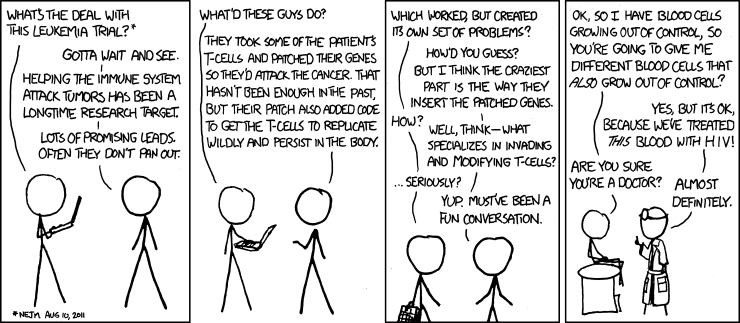
Today's xkcd is timely.


Here is the news article that's being referenced in the comic.

Fortunately, I saw this episode of Star Trek. I know what happens when you screw around with T-Cells. Be careful, science!

Saturday, August 13, 2011

SF Cell Shutdown: Safety Issue, Or Hint Of Orwell?


An illegal, Orwellian violation of free-speech rights? Or just a smart tactic to protect train passengers from rowdy would-be demonstrators during a busy evening commute?
The question resonated Saturday in San Francisco and beyond as details emerged of Bay Area Rapid Transit officials' decision to cut off underground cellphone service for a few hours at several stations Thursday. Commuters at stations from downtown to near the city's main airport were affected as BART officials sought to tactically thwart a planned protest over the recent fatal shooting of a 45-year-old man by transit police.
Two days later, the move had civil rights and legal experts questioning the agency's move, and drew backlash from one transit board member who was taken aback by the decision.
"I'm just shocked that they didn't think about the implications of this. We really don't have the right to be this type of censor," said Lynette Sweet, who serves on BART's board of directors. "In my opinion, we've let the actions of a few people affect everybody. And that's not fair."
Similar questions of censorship have arisen in recent days as Britain's government put the idea of curbing social media services on the table in response to several nights of widespread looting and violence in London and other English cities. Police claim that young criminals used Twitter and Blackberry instant messages to coordinate looting sprees in riots.
Prime Minister David Cameron said that the government, spy agencies and the communications industry are looking at whether there should be limits on the use of social media sites like Twitter and Facebook or services like BlackBerry Messenger to spread disorder. The suggestions have met with outrage — with some critics comparing Cameron to the despots ousted during the Arab Spring.
In the San Francisco instance, Sweet said BART board members were told by the agency of its decision during the closed portion of its meeting Thursday afternoon, less than three hours before the protest was scheduled to start.
"It was almost like an afterthought," Sweet told The Associated Press. "This is a land of free speech and for us to think we can do that shows we've grown well beyond the business of what we're supposed to be doing and that's providing transportation. Not censorship."

Complete source article here.

Regardless of why they wanted to organize protest, this wasn't the right response. I think it's pretty bad when the board of director's are immediately questioning the action.

Friday, July 22, 2011

UK scientists call for new agency to oversee experiments mixing human and animal cells

Get your hands off me you damn, dirty apes!


LONDON — British scientists say a new expert body should be formed to regulate experiments mixing animal and human DNA to make sure no medical or ethical boundaries are crossed.
In a report issued on Friday, scientists at the nation’s Academy of Medical Sciences said a government organization is needed to advise whether certain tests on animals that use human DNA should be pursued.
[snip]
Among experimentation that might spark concern are those where human brain cells might change animal brains, those that could lead to the fertilization of human eggs in animals and any modifications of animals that might create attributes considered uniquely human, like facial features, skin or speech. 

Source.

And ok. Maybe I'm being a bit dramatic. Maybe I'm not. I'm just saying, the great monkey/human wars may be upon us. And I, for one, won't welcome our overlords.

Tuesday, July 19, 2011

Scientist: Tae Bo workout sent skyscraper shaking

I don't know that it has anything to do with resonance frequency, but the imaginary engineer in my mind would like to think that this is the case. From a source article at CNN:

Seventeen people performing a vigorous Tae Bo workout caused tremors that forced the evacuation of a South Korean skyscraper earlier this month, the building's owners say.
Prime Group, owner of the 39-story TechnoMart commercial-residential high-rise in Seoul, said 17 middle-aged people were working out to the pop song "The Power" by Snap on July 5 when their movements set the upper floors of the tower shaking for 10 minutes, according to a report from the Korea JoongAng Daily.
Scientists recreated the event in the 12th floor gym, according to a report in the Korea Times.
“We observed the vibrometer while performing the same kind of aerobic exercise that was performed at the time of the shaking which occurred on July 5. We noticed that the shaking was felt in the upper floors while the exercise was being performed while no other place showed signs of tremor,” Chung Lan, a professor of architectural engineering at Dankook University, told the Korea Times. 
“It just happens to be that the vibration cycle caused by Tae Bo collided with the vertical vibration cycle unique to the building,” Chung told the Korea Times. The action amplified the building's vibration and caused the shaking, he said. 
Chung was one of six professors from the Architectural Institute of Korea who inspected the building and recreated the Tae Bo exercise.

So, essentially they were a large, nerdy, Korean earthquake machine. They'd make Tesla proud. If there is a better reason to go back to school for an engineering degree, I don't know what it is.

Tim Harford: Trial, error and the God complex


Surprisingly capitalistic for TED.

I could say a lot about making it ok to fail in schools, but I think that would be a bit too divergent.

Friday, July 15, 2011

Internet Use Affects Memory

I had an interesting discussion with a professor about two years ago regarding our living in the information age. I don't even remember how it came up, but I postulated that rote memorization of facts is falling by the wayside as a result of the easy access of information at our fingertips. Why do I need to memorize my Greek lute tunings? If I ever need to know them, I'll be able to look them up on the fly. They're not something I need to know on a regular basis, but if I do, I have Google, encyclopedias (both wiki, and paid), online scholarly journals, old textbooks (looking at you, Grout), etc, etc. The information is stored in a very accessible manner, and gone are the days when needing to know something minute meant six hours in a library digging through books hoping against hope you'll find the answer you need. Information has truly become populist in accessibility.

Furthermore, anything you do need to recall quickly and on a regular basis, you will be able to because of repetition. If you use the information on a regular basis, you'll retain it. That's how our minds work. If not, you know where to find it. We won't become a society of inane robots who don't recall anything, rather we'll simply use our minds more efficiently, retaining that which is vital, which access to those facts that are less so.

And while clearly alien to this professor's experience, I could tell he didn't entirely disagree. Not sure he totally agreed with my viewpoint, but there was clearly some honest consideration of truth in my prediction.

Well, while I was blowing hot air about it, apparently scientists were actually researching it.

Abstract from study:

The advent of the Internet, with sophisticated algorithmic search engines, has made accessing information as easy as lifting a finger. No longer do we have to make costly efforts to find the things we want. We can "Google" the old classmate, find articles online, or look up the actor who was on the tip of our tongue. The results of four studies suggest that when faced with difficult questions, people are primed to think about computers and that when people expect to have future access to information, they have lower rates of recall of the information itself and enhanced recall instead for where to access it. The Internet has become a primary form of external or transactive memory, where information is stored collectively outside ourselves.

And from the NY Times article where I first encountered this bit of info:

The scientists, led by  Betsy Sparrow, an assistant professor of psychology at Columbia, wondered whether  people were more likely to remember information that could be easily retrieved from a computer, just as students are more likely to recall facts they believe will be on a test.
Dr. Sparrow and her collaborators, Daniel M. Wegner of Harvard and Jenny Liu of the University of Wisconsin, Madison, staged four different memory experiments. In one, participants typed 40 bits of trivia — for example, “an ostrich’s eye is bigger than its brain” — into a computer. Half of the subjects believed the information would be saved in the computer; the other half believed the items they typed would be erased. 
The subjects were significantly more likely to remember information if they thought they would not be able to find it later. “Participants did not make the effort to remember when they thought they could later look up the trivia statement they had read,” the authors write. 
A second experiment was aimed at determining whether computer accessibility affects precisely what we remember. “If asked the question whether there are any countries with only one color in their flag, for example,” the researchers wrote, “do we think about flags — or immediately think to go online to find out?”
In this case, participants were asked to remember both the trivia statement itself and which of five computer folders it was saved in. The researchers were surprised to find that people seemed better able to recall the folder. 
“That kind of blew my mind,” Dr. Sparrow said in an interview. 

The argument being made is that teachers might now start focusing more on broad concepts and synthesis than facts in their teaching style. (Which I think is something they should be doing anyway, but no one asks me.) Whether or not this will affect educational philosophy, I imagine we won't know for another decade or two, given how slowly these gears tend to grind.