Today's xkcd is timely.
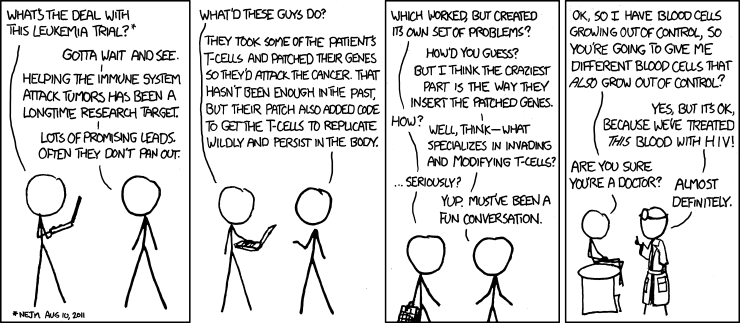
Here is the news article that's being referenced in the comic.
Fortunately, I saw this episode of Star Trek. I know what happens when you screw around with T-Cells. Be careful, science!
An illegal, Orwellian violation of free-speech rights? Or just a smart tactic to protect train passengers from rowdy would-be demonstrators during a busy evening commute?
The question resonated Saturday in San Francisco and beyond as details emerged of Bay Area Rapid Transit officials' decision to cut off underground cellphone service for a few hours at several stations Thursday. Commuters at stations from downtown to near the city's main airport were affected as BART officials sought to tactically thwart a planned protest over the recent fatal shooting of a 45-year-old man by transit police.
Two days later, the move had civil rights and legal experts questioning the agency's move, and drew backlash from one transit board member who was taken aback by the decision.
"I'm just shocked that they didn't think about the implications of this. We really don't have the right to be this type of censor," said Lynette Sweet, who serves on BART's board of directors. "In my opinion, we've let the actions of a few people affect everybody. And that's not fair."
Similar questions of censorship have arisen in recent days as Britain's government put the idea of curbing social media services on the table in response to several nights of widespread looting and violence in London and other English cities. Police claim that young criminals used Twitter and Blackberry instant messages to coordinate looting sprees in riots.
Prime Minister David Cameron said that the government, spy agencies and the communications industry are looking at whether there should be limits on the use of social media sites like Twitter and Facebook or services like BlackBerry Messenger to spread disorder. The suggestions have met with outrage — with some critics comparing Cameron to the despots ousted during the Arab Spring.
In the San Francisco instance, Sweet said BART board members were told by the agency of its decision during the closed portion of its meeting Thursday afternoon, less than three hours before the protest was scheduled to start.
"It was almost like an afterthought," Sweet told The Associated Press. "This is a land of free speech and for us to think we can do that shows we've grown well beyond the business of what we're supposed to be doing and that's providing transportation. Not censorship."
LONDON — British scientists say a new expert body should be formed to regulate experiments mixing animal and human DNA to make sure no medical or ethical boundaries are crossed.
In a report issued on Friday, scientists at the nation’s Academy of Medical Sciences said a government organization is needed to advise whether certain tests on animals that use human DNA should be pursued.
[snip]
Among experimentation that might spark concern are those where human brain cells might change animal brains, those that could lead to the fertilization of human eggs in animals and any modifications of animals that might create attributes considered uniquely human, like facial features, skin or speech.
Seventeen people performing a vigorous Tae Bo workout caused tremors that forced the evacuation of a South Korean skyscraper earlier this month, the building's owners say.
Prime Group, owner of the 39-story TechnoMart commercial-residential high-rise in Seoul, said 17 middle-aged people were working out to the pop song "The Power" by Snap on July 5 when their movements set the upper floors of the tower shaking for 10 minutes, according to a report from the Korea JoongAng Daily.
Scientists recreated the event in the 12th floor gym, according to a report in the Korea Times.
“We observed the vibrometer while performing the same kind of aerobic exercise that was performed at the time of the shaking which occurred on July 5. We noticed that the shaking was felt in the upper floors while the exercise was being performed while no other place showed signs of tremor,” Chung Lan, a professor of architectural engineering at Dankook University, told the Korea Times.
“It just happens to be that the vibration cycle caused by Tae Bo collided with the vertical vibration cycle unique to the building,” Chung told the Korea Times. The action amplified the building's vibration and caused the shaking, he said.
Chung was one of six professors from the Architectural Institute of Korea who inspected the building and recreated the Tae Bo exercise.
The advent of the Internet, with sophisticated algorithmic search engines, has made accessing information as easy as lifting a finger. No longer do we have to make costly efforts to find the things we want. We can "Google" the old classmate, find articles online, or look up the actor who was on the tip of our tongue. The results of four studies suggest that when faced with difficult questions, people are primed to think about computers and that when people expect to have future access to information, they have lower rates of recall of the information itself and enhanced recall instead for where to access it. The Internet has become a primary form of external or transactive memory, where information is stored collectively outside ourselves.
The scientists, led by Betsy Sparrow, an assistant professor of psychology at Columbia, wondered whether people were more likely to remember information that could be easily retrieved from a computer, just as students are more likely to recall facts they believe will be on a test.
Dr. Sparrow and her collaborators, Daniel M. Wegner of Harvard and Jenny Liu of the University of Wisconsin, Madison, staged four different memory experiments. In one, participants typed 40 bits of trivia — for example, “an ostrich’s eye is bigger than its brain” — into a computer. Half of the subjects believed the information would be saved in the computer; the other half believed the items they typed would be erased.
The subjects were significantly more likely to remember information if they thought they would not be able to find it later. “Participants did not make the effort to remember when they thought they could later look up the trivia statement they had read,” the authors write.
A second experiment was aimed at determining whether computer accessibility affects precisely what we remember. “If asked the question whether there are any countries with only one color in their flag, for example,” the researchers wrote, “do we think about flags — or immediately think to go online to find out?”
In this case, participants were asked to remember both the trivia statement itself and which of five computer folders it was saved in. The researchers were surprised to find that people seemed better able to recall the folder.
“That kind of blew my mind,” Dr. Sparrow said in an interview.
Terrorists intent on striking commercial aircraft have shown renewed interest in surgically implanting explosives or explosive components in humans to conduct attacks, a U.S. security official tells CNN.
Hopefully nothing more will come of this. I have no idea how they'd check for bombs in recently closed surgery wounds.
The idea of implanting bombs has been discussed in the past, but the United States has obtained fresh intelligence about the desire of terrorists, and there is new intelligence about a possible technique that could be used, according to the official, who declined to elaborate.
Source.
Full-body scanners, or what the TSA calls "Advanced Imaging Technology," cannot detect items inserted in bodies. But the machines can help screeners detect alterations to body contours, which can be a clue that someone may be concealing a bomb.
Buying used video games is great for gamers who don't want to pay full price for the latest hits. You know who doesn't like used video games? Game publishers. In a very sad twist, Capcom's fighting back against the second-hand game market with a game that can only support one save file — for life.
It's been confirmed that Resident Evil: Mercenaries 3D for the Nintendo 3DS is a game that once finished, cannot be reset for complete replay. According to both the U.S. and U.K. game's instruction manual "saved data on this software cannot be reset."
Basically what Capcom has done is make Mercenaries 3D a one-time play affair. Once you've unlocked all the goodies and played the entire game, you will not be able to erase the game's save data and start fresh as if it were a new copy. Consider this: lendingMercenaries 3D to a friend, a little brother or sister will be worthless because they'll only be able to continue playing
the game with your saved settings and create their own.We get that game publishers don't make any money off sales from used video games, but killing off the ability to hit the reset button is just taking things too far. It's like saying Upperdeck is entitled to a cut in my autographed Michael Jordan basketball card I sold at a garage sale for $10,000 some 25 years after I bought it.
While it can be argued that used video game sales are actually more damaging than piracy, it's still a lowball move for Capcom to make, especially with a franchise as large and significant as theResident Evil series. Will other publishers follow in Capcom's footsteps to take a stand against the lucrative market of used video games? We really hope this isn't a sign of things to come.
Tiny Cartridge, via Eurogamer
California Assembly Bill 1179 (2005), Cal. Civ. Code Ann. §§1746–1746.5 (West 2009) (Act), prohibits the sale or rental of “violent video games” to minors, and requires their packaging to be labeled “18.” The Act covers games “in which the range of options available to a player includes killing, maiming, dismembering, or sexually assaulting an image of a human being, if those acts are depicted” in a manner that “[a] reasonable person, considering the game as a whole, would find appeals to a deviant or morbid interest of minors,” that is “patently offensive to prevailing standards in the community as to what is suitable for minors,” and that “causes the game, as a whole, to lack serious literary, artistic, political, or scientific value for minors.” §1746(d)(1)(A). Violation of the Act is punishable by a civil fine of up to $1,000. §1746.3.
California correctly acknowledges that video games qualify for First Amendment protection. The Free Speech Clause exists principally to protect discourse on public matters, but we have long recognized that it is difficult to distinguish politics from entertainment, and dangerous to try. “Everyone is familiar with instances of propaganda through fiction. What is one man’s amusement, teaches another’s doctrine.” Winters v. New York, 333 U. S. 507, 510 (1948). Like the protected books, plays, and movies that preceded them, video games communicate ideas—and even social messages—through many familiar literary devices (such as characters, dialogue, plot, and music) and through features distinctive to the medium (such as the player’s interaction with the virtual world). That suffices to confer First Amendment protection. Under our Constitution, “esthetic and moral judgments about art and literature . . . are for the individual to make, not for the Government to decree, even with the mandate or approval of a majority.” United States v. Playboy Entertainment Group, Inc., 529 U. S. 803, 818 (2000).Good stuff. Scalia clearly understand the intent of the law, and what Free Speech truly means. More:
The California Act is something else entirely. It does not adjust the boundaries of an existing category of unprotected speech to ensure that a definition designed for adults is not uncritically applied to children. California does not argue that it is empowered to prohibit selling offensively violent works to adults—and it is wise not to, since that is but a hair’s breadth from the argument rejected in Stevens. Instead, it wishes to create a wholly new category of content-based regulation that is permissible only for speech directed at children.Snip.
That is unprecedented and mistaken. “[M]inors are entitled to a significant measure of First Amendment protection, and only in relatively narrow and well-defined circumstances may government bar public dissemination of protected materials to them.” Erznoznik v. Jacksonville, 422 U. S. 205, 212–213 (1975) (citation omitted). No doubt a State possesses legitimate power to protect children from harm, Ginsberg, supra, at 640–641; Prince v. Massachusetts, 321 U. S. 158, 165 (1944), but that does not include a free-floating power to restrict the ideas to which children may be exposed. “Speech that is neither obscene as to youths nor subject to some other legitimate proscription cannot be suppressed solely to protect the young from ideas or images that a legislative body thinks unsuitable for them.” Erznoznik, supra, at 213–214.3
California claims that video games present special problems because they are “interactive,” in that the player participates in the violent action on screen and determines its outcome. The latter feature is nothing new: Since at least the publication of The Adventures of You: Sugarcane Island in 1969, young readers of choose-your-ownadventure stories have been able to make decisions that determine the plot by following instructions about which page to turn to.
JUSTICE ALITO has done considerable independent research to identify, see post, at 14–15, nn. 13–18, video games in which “the violence is astounding,” post, at 14. “Victims are dismembered, decapitated, disemboweled, set on fire, and chopped into little pieces. . . . Blood gushes, splatters, and pools.” Ibid. JUSTICE ALITO recounts all these disgusting video games in order to disgust us—butdisgust is not a valid basis for restricting expression. And the same is true of JUSTICE ALITO’s description, post, at 14–15, of those video games he has discovered that have a racial or ethnic motive for their violence—“ ‘ethnic cleansing’ [of] . . . African Americans, Latinos, or Jews.” To what end does he relate this? Does it somehow increase the “aggressiveness” that California wishes to suppress? Who knows? But it does arouse the reader’s ire, and the reader’s desire to put an end to this horrible message. Thus, ironically, JUSTICE ALITO’s argument highlights the precise danger posed by the California Act: that the ideas expressed by speech—whether it be violence, or gore, or racism—and not its objective effects, may be the real reason for governmental proscription.
And as a means of assisting concerned parents it is seriously overinclusive because it abridges the First Amendment rights of young people whose parents (and aunts and uncles) think violent video games are a harmless pastime. And the overbreadth in achieving one goal is not cured by the underbreadth in achieving the other. Legislation such as this, which is neither fish nor fowl, cannot survive strict scrutiny.
(CNN) -- The Transportation Security Administration stood by its security officers Sunday after a Florida woman complained that her cancer-stricken, 95-year-old mother was patted down and forced to remove her adult diaper while going through security.
Reports of the incident took hold in social media, with scores of comments on the topic and reposts appearing hourly on Twitter Sunday afternoon. The TSA released a statement Sunday defending its agents' actions at the Northwest Florida Regional Airport.
"While every person and item must be screened before entering the secure boarding area, TSA works with passengers to resolve security alarms in a respectful and sensitive manner," the federal agency said. "We have reviewed the circumstances involving this screening and determined that our officers acted professionally and according to proper procedure."
The right of the people to be secure in their persons, houses, papers, and effects, against unreasonable searches and seizures, shall not be violated, and no Warrants shall issue, but upon probable cause, supported by oath or affirmation, and particularly describing the place to be searched, and the persons or things to be seized.
WASHINGTON — The Federal Bureau of Investigation is giving significant new powers to its roughly 14,000 agents, allowing them more leeway to search databases, go through household trash or use surveillance teams to scrutinize the lives of people who have attracted their attention.
The F.B.I. recently briefed several privacy advocates about the coming changes. Among them, Michael German, a former F.B.I. agent who is now a lawyer for the American Civil Liberties Union, argued that it was unwise to further ease restrictions on agents’ power to use potentially intrusive techniques, especially if they lacked a firm reason to suspect someone of wrongdoing.

